
As an Amazon Associate we earn from qualifying purchases.
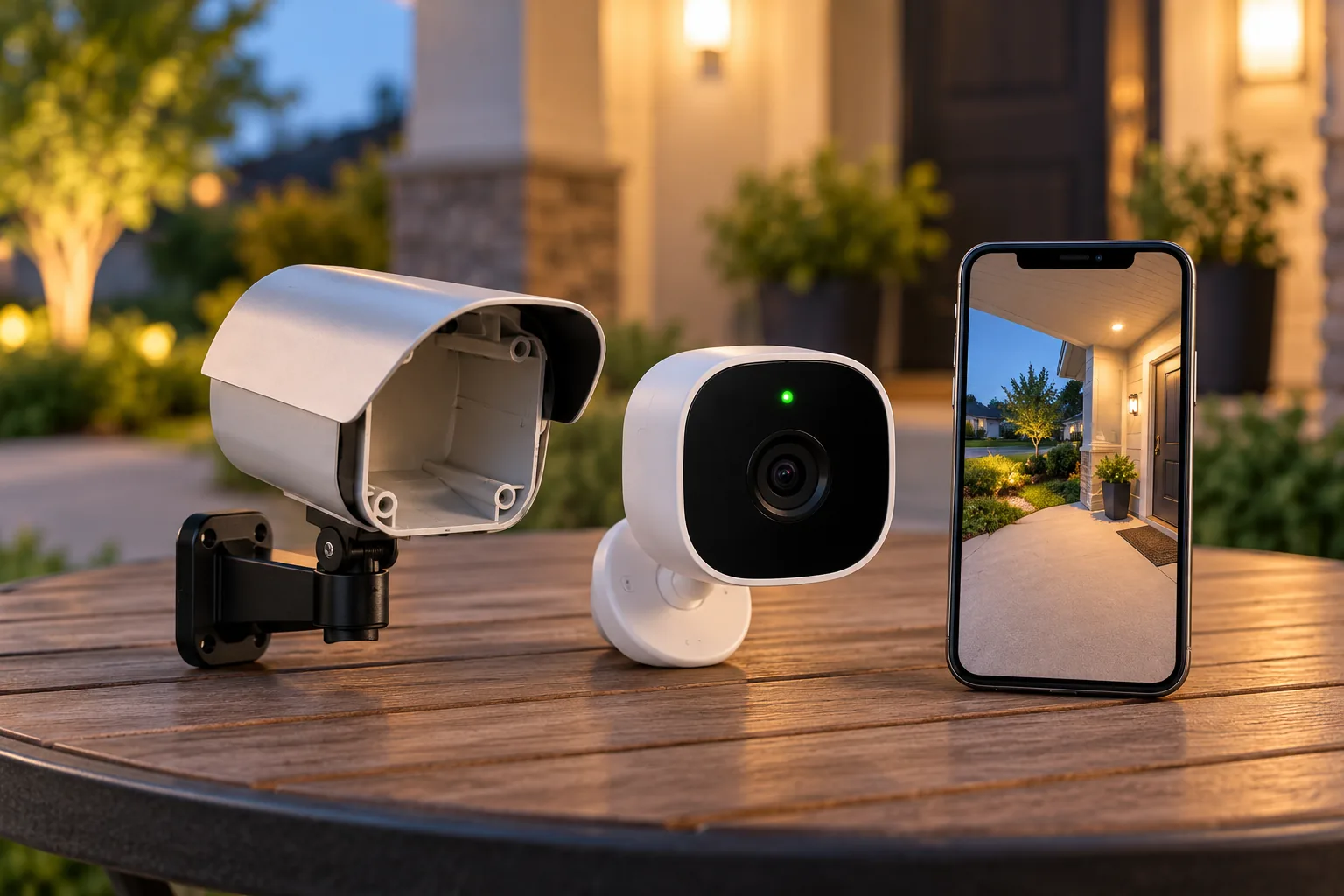
Outdoor fake security cameras are appearance-only props. Choose a working camera if you need to see an entrance remotely, receive motion alerts or retrieve footage after an incident. An imitation housing cannot provide any of those functions, regardless of how convincing it looks from the sidewalk.
Quick decision: A dummy may meet a purely visual goal, but its effect on a particular visitor's behavior is uncertain. A real camera gives you functional capabilities to configure and verify. Neither guarantees that a crime will be prevented or that a recording will identify someone.
As an Amazon Associate, we earn from qualifying purchases. We may earn a commission when you buy through links on this page.
This comparison is for US homeowners deciding whether camera appearance is enough for their goal. It uses product documentation and an official CCTV evidence summary, checked October 18, 2026. It includes no hands-on deterrence test or claim that one household's outcome can be predicted from broader research.
In this guide
- Compare the capability you actually need
- What deterrence research can tell you
- Two functional alternatives and their obligations
- Compare complete cost instead of shell price
- A working camera needs a recording check
- Frame the view thoughtfully
- Questions that settle dummy versus real
Compare the capability you actually need
Swann describes its PRO-MSBDUM imitation as using the same case as a real camera without the internals. That is a useful illustration of what a dummy is: the exterior resemblance does not make it a recording device. The source is an Australian product page, so it establishes that product's identity rather than US purchase availability. Source: Swann imitation camera.
| Goal or requirement | Dummy camera | Functioning camera |
|---|---|---|
| Camera-shaped visual presence | Its primary purpose | Often visible as installed |
| Live view of an entrance | Unavailable | Available on a supported, connected model |
| Motion alert to your phone | Unavailable | Requires supported detection, setup and connectivity |
| Saved footage | Unavailable | Requires configured recording and suitable storage |
| Two-way conversation | Unavailable | Requires a model with the feature and a working connection |
| Evidence after an incident | No footage to retrieve | Depends on what was actually recorded and retained |
| Maintenance | Mount and exterior condition; any accessory power needs | Mount, power, network, settings and storage checks |
The functional examples below are documented cameras with live view, audio and detection. “Real” does not automatically mean recording is enabled or included in the base purchase. A working device can still fail your goal if you overlook its storage requirements.
Begin with one observable outcome
For example, a homeowner who wants to check whether a delivery has reached the porch needs an actual image. A dummy cannot answer that question. A homeowner who wants a saved clip after someone enters the driveway needs a real recording path and a way to retrieve the footage.
A purely visual goal is narrower: placing a camera-shaped object in view. You can verify that the object is visible, but you cannot infer that every person notices it or changes behavior. Treat the presumed reaction as uncertain instead of counting the prop as a functioning monitoring position.
Outdoor camera placement starts with what the camera must see. If the essential entrance is covered only by a dummy, it remains an entrance without video coverage, even when the exterior arrangement looks complete.
What deterrence research can tell you
The College of Policing's CCTV evidence summary, updated October 1, 2021, draws primarily on a review of 76 studies. Of those, 34 were conducted in the UK and 24 in the US. It concerns operating CCTV schemes across settings, including car parks and residential areas. It is not an experiment comparing imitation and functioning cameras on individual US homes.
The summary reports that effects vary by context and identifies active monitoring, coverage and complementary interventions as relevant factors. It also says the proposed mechanisms explaining how CCTV might affect behavior were not empirically tested in the reviewed studies. Those boundaries matter: evidence about an operating surveillance scheme cannot establish a deterrence percentage for an empty plastic housing.
This evidence supports a cautious purchasing rule. Choose the real camera's functions because you need them, and assess whether the installation can perform the intended job. Do not calculate a promised reduction in your household's risk by applying a study average, and do not assume a visible lens alone accounts for the outcomes of monitored CCTV schemes.
Swann's 2018 guide to fake cameras suggests combining real and imitation units. That is vendor advice rather than measured proof that a mixed installation produces the same result as recording cameras at every required viewpoint. Its old purchase-cost examples are also unsuitable for establishing today's US shopping budget.
Does a mixed installation make sense?
Only assess it after separating visual positions from recording positions. Draw every view that must produce footage, then mark which working camera supplies that view. A dummy at another position adds no footage from there.
Suppose the porch and side gate both need recordings, but the budget covers one complete working-camera installation. Placing that camera at the porch and a dummy at the gate does not resolve the gate's recording requirement. You still need to decide which view is the priority, whether another functional arrangement is feasible, or whether the uncovered requirement is acceptable.
That decision is clearer than treating two visible housings as two-camera coverage. No direct dummy-versus-real household trial in the evidence used here establishes the deterrence value of the proposed mixture.
Two functional alternatives and their obligations
These examples show how a real-camera purchase differs from buying an imitation shell. They are not an exhaustive ranking or a claim about current price or stock.
Blink Mini 2: include the outdoor power adapter and recording path
Blink Mini 2 is a plug-in camera with 1080p video, motion detection, a spotlight, live view and two-way audio. It does not use batteries. Blink's FAQ says outdoor IP65 use requires the specified Weather Resistant Power Adapter, sold separately. An ordinary indoor USB cable is not a substitute for that documented outdoor arrangement. Source: Mini 2 FAQ.
Local storage requires Sync Module 2. Optional cloud storage and Person Detection have subscription conditions. The module is not required merely to operate Mini 2, so distinguish “camera works” from “camera has my chosen local recording arrangement.” That difference affects the complete setup cost.
Mini 2 is relevant when a suitable outdoor power installation and Wi-Fi are available and its recording path meets your needs. Search Amazon for Blink Mini 2 and its outdoor power adapter, then verify which accessories the selected package contains.
Tapo C120: local card storage with optional cloud
The Tapo C120 uses 5V DC power and Wi-Fi. The documented local option is a separately purchased microSD card up to 512GB, while Tapo Care cloud storage requires a subscription. The product page describes free AI detection for people, pets and vehicles and a magnetic mounting base. Source: Tapo C120 specifications and FAQ.
This is an example of a working-camera path where a cloud plan is not the only route to recordings. It still needs power, compatible storage, configuration and verification. “No required cloud subscription” should not be read as “no accessories or maintenance.”
Search Amazon for Tapo C120 cameras when comparing complete packages. Search results do not verify compatibility, current price or availability.
Compare complete cost instead of shell price
Write a separate total for each functional arrangement. Include the camera, required outdoor power accessories, storage card or module, mounting needs and any optional subscription you intend to use. The lowest camera-only price may omit the part that makes your recording plan work.
For a dummy, check the mount, exterior suitability and any accessory or indicator maintenance specified for that exact product. A blinking light or a small solar accessory, if included on a particular imitation, does not establish that it records. Read the actual function list instead of interpreting the appearance as evidence.
| Budget item | Question to answer before purchase |
|---|---|
| Camera or imitation | What documented function am I buying? |
| Outdoor installation | Are the required adapter and mounting parts included? |
| Recording hardware | Is a card, module or other device needed? |
| Optional service | Which specific features require a subscription? |
| Maintenance | Can I safely reach and check the installation? |
| Expansion | Does another camera add a needed viewpoint or merely repeat it? |
Security cameras without subscription can still have storage and installation costs. Compare an entire usable system with another entire usable system, then decide whether the additional functions justify the difference for your goal.
A working camera needs a recording check
After installing a real camera, confirm more than the live picture. Generate a planned motion event, look for the expected alert and replay the new clip. Verify that the timestamp and view correspond to the event you created. Check how to save a copy before older footage is overwritten or your chosen service's retention period ends.
A notification is not itself a permanent recording archive. Likewise, an inserted storage card is not proof that the camera is saving clips. Security camera recording options should be part of setup, including whether you want event clips and what happens when storage fills.
Include outdoor camera installation and routine checks in the plan for the functions you rely on. Confirm that the mount still holds the required view, power is present, the connection works and new footage can be replayed. A real camera earns its place through those working functions, not through its housing alone.
Frame the view thoughtfully
Point the working camera at the approach you need to monitor and minimize unnecessary views into neighboring private spaces. Review microphone and any biometric-feature settings before enabling them. Google's privacy guidance for Nest products emphasizes appropriate framing and checking the requirements that apply where video, audio or biometric features are used.
That guidance does not grant permission for your particular property. If a shared entrance, rental arrangement or disputed boundary creates uncertainty, resolve it before installation. Keep the buying decision focused on footage you actually need rather than maximizing how much unrelated space appears in the frame.
Questions that settle dummy versus real
Can an imitation camera supply evidence after an incident?
No. A nonfunctioning imitation has no footage to retrieve. A real camera can supply footage only when the relevant view was recorded, retained and recoverable. Check those functions rather than assuming every camera-shaped object or connected app provides evidence.
Is cloud storage mandatory for a real camera?
No universal rule applies. Tapo C120 has a separately purchased microSD option; Mini 2 offers local storage through Sync Module 2. Cloud services and specific advanced features have their own terms. Choose the exact recording arrangement before comparing total costs.
Should a dummy be the first purchase?
If you need live view, an alert or saved footage, prioritize a complete functional installation at the most important approach. If the goal is solely a visible prop, acknowledge that limited function and uncertain deterrence. Do not count it as video coverage.
The decision between outdoor fake security cameras and working cameras comes down to what you must be able to do afterward. Complete the cost worksheet, identify the essential viewpoint and verify recording there. That gives you a practical, checkable result while keeping deterrence expectations within the limits of the evidence.